
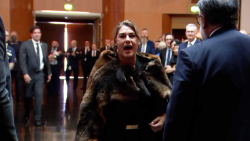

In a bold move that has reignited Australia’s debate on its ties to the British monarchy, an Australian lawmaker confronted members of the British royal family during their visit to the country, declaring, “You are not my king.” The statement, made during a formal engagement, has sparked widespread attention and reopened discussions about Australia’s future as a constitutional monarchy.
The Confrontation
The comment was made by Senator Lidia Thorpe, a prominent member of the Australian Greens and a vocal advocate for Indigenous rights and republicanism. Thorpe’s confrontation occurred during an event held in Sydney, attended by senior members of the British royal family as part of their official tour to celebrate Australia’s long-standing relationship with the UK.
Thorpe, who has previously expressed opposition to the monarchy, did not mince words. In front of media and officials, she publicly denounced the royals, stating, “You are not my king,” in reference to King Charles III. Thorpe went on to emphasize that the British monarchy’s presence in Australia represents a colonial legacy that continues to marginalize Indigenous Australians.
“I represent the First Nations people of this land, and we have never ceded sovereignty,” Thorpe declared. “Your monarchy was built on the dispossession and suffering of my ancestors, and it’s time for Australia to stand on its own two feet.”
Reigniting the Republic Debate
Thorpe’s bold statement has struck a chord with many Australians who are questioning the relevance of the British monarchy in modern Australia. While the nation remains part of the Commonwealth with King Charles III as its head of state, there has been growing support for the idea of Australia becoming a republic, especially following the death of Queen Elizabeth II in 2022.
The debate over whether Australia should sever its constitutional ties with the monarchy is not new. In 1999, a national referendum on the issue saw voters narrowly reject the move to become a republic. However, recent polls suggest that public opinion is shifting, particularly among younger Australians, many of whom see the monarchy as outdated and irrelevant to Australia’s future.
Prime Minister Anthony Albanese’s government has expressed support for holding another referendum on the issue, although no specific timeline has been set. Thorpe’s confrontation with the royals may add pressure for the government to address the republican movement more directly, as the debate continues to gain momentum.
Indigenous Rights and the Monarchy
Thorpe’s remarks also highlight the ongoing struggle for Indigenous rights in Australia. For many First Nations people, the British monarchy is a symbol of colonialism and the systemic injustices that Indigenous Australians have faced since British colonization began in 1788. Thorpe has been a staunch advocate for Indigenous sovereignty and has called for a treaty with Australia’s First Nations people to formally recognize their land rights and cultural heritage.
In her confrontation, Thorpe pointed to the continued lack of formal recognition for Indigenous Australians in the country’s constitution, as well as the government’s failure to address issues such as land dispossession, social inequality, and cultural erasure. Her criticism jawabet of the monarchy was a direct challenge to the institution’s historical role in Australia’s colonization, which led to the displacement and suffering of Indigenous communities.
“This land was never ceded, and the Crown’s claim over it is based on the lie of terra nullius,” Thorpe said, referring to the doctrine used to justify British colonization, which falsely asserted that Australia was uninhabited prior to European settlement. “We must reckon with this history if we are to move forward as a nation.”
Public Reaction
Thorpe’s confrontation has sparked mixed reactions across Australia. Supporters of the republican movement have praised her for speaking truth to power and highlighting the need for Australia to take control of its own destiny. Many have echoed her call for a more serious conversation about the future of the monarchy and the country’s relationship with the British royal family.
“Senator Thorpe is absolutely right,” said Matt Thistlethwaite, Assistant Minister for the Republic. “It’s time for Australia to have a head of state that is one of our own, someone who lives here, understands our culture, and reflects our values.”
However, conservative commentators and monarchists have condemned Thorpe’s actions as disrespectful, accusing her of politicizing what was meant to be a ceremonial visit by the royals. Peter Dutton, leader of the opposition Liberal Party, called her remarks “an embarrassing spectacle” and criticized her for using the occasion to push a political agenda.
“The monarchy has been a stable and enduring part of Australia’s history, and these attacks on the royal family are divisive,” Dutton said. “Australians value their connection to the Commonwealth, and this kind of grandstanding does nothing to address the real issues facing our country.”
The Future of Australia’s Monarchy
Thorpe’s challenge to the British royals has brought the question of Australia’s constitutional future back into the national spotlight. While the prospect of another referendum on the republic remains uncertain, the conversation about Australia’s identity, its colonial past, and the role of the monarchy is far from over.
With growing support for republicanism and increasing calls for Indigenous recognition and justice, the pressure is mounting for Australia to chart its own course—one that reflects the diverse and multicultural nation it has become.
Whether this moment will lead to significant political change remains to be seen, but for many Australians, Thorpe’s statement has captured the growing sentiment that the British monarchy’s time in Australia may be nearing its end. As the country grapples with its colonial legacy and seeks a more inclusive future, the question of whether to remain tied to the monarchy is likely to persist as a defining issue in Australian politics.