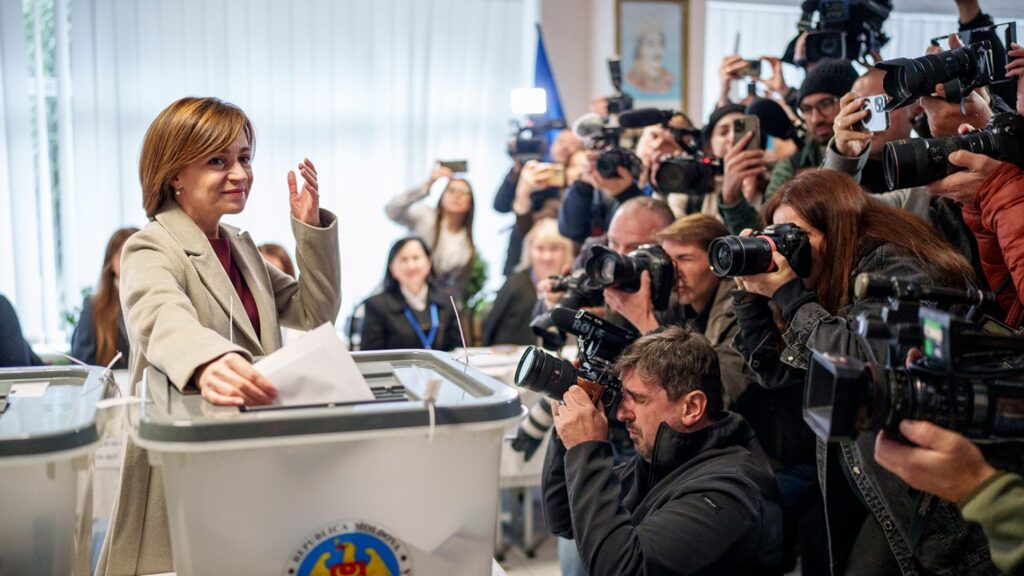

Moldova’s upcoming referendum on joining the European Union is facing growing uncertainty, with the country’s president, Maia Sandu, condemning what she describes as an ongoing “assault on democracy” aimed at derailing the vote. As tensions rise in the small Eastern European nation, the referendum, seen as a pivotal moment in Moldova’s future, has become a flashpoint in the broader geopolitical struggle between the West and Russia.
The Referendum: A Historic Decision
Scheduled for later this year, the referendum will ask Moldovan citizens whether they want to pursue full membership in the European Union. Moldova, a former Soviet republic, has been at a political crossroads for years, caught between pro-European aspirations and historical ties to Russia. President Sandu and her government have pushed for deeper integration with the EU, arguing that it is the best path toward economic development, democratic reforms, and security in the face of growing regional instability.
However, opposition forces, backed by pro-Russian elements, have mounted fierce resistance, casting doubt on the integrity of the referendum. They claim that Moldova’s alignment with the EU would sever long-standing ties with Russia, leading to economic challenges and compromising the country’s neutrality. These tensions have been exacerbated by the war in neighboring Ukraine, as Moldova faces mounting pressure from both sides of the geopolitical divide.
President Sandu’s Strong Words
In a recent address, President Maia Sandu did not mince words, accusing her political opponents of undermining the democratic process. “There is a coordinated assault on our democracy,” Sandu said, referring to a series of efforts she claims are aimed at sowing confusion and disrupting the referendum. She pointed to disinformation campaigns, organized protests, and attempts to intimidate pro-EU officials as evidence of a broader strategy to sabotage the vote.
“The people of Moldova have the right to decide their future without fear or manipulation,” Sandu stated. “This referendum is about our place in the world, our values, and our security. It is crucial that this process remains fair, transparent, and free from external influence.”
Sandu’s government has accused Russia of meddling in Moldova’s internal affairs, alleging that Moscow is supporting opposition groups to prevent the country from moving closer to the West. Moldova, which relies heavily on Russian energy supplies, has found itself increasingly vulnerable to political and economic pressure from the Kremlin, a situation that has only worsened since the start of the conflict in Ukraine.
Opposition Pushback
Opposition leaders have dismissed Sandu’s accusations, arguing that they are jawabet88 simply defending Moldova’s sovereignty and its neutral status. Igor Dodon, the former president and a key pro-Russian figure, has led the charge against the EU referendum, warning that integration with the West would lead to economic hardship for Moldovans.
“Joining the EU is not the solution to our problems,” Dodon said in a public statement. “Moldova must remain a neutral country. We cannot afford to be dragged into a geopolitical conflict that will harm our economy and destabilize our society.”
Dodon and other opposition leaders have accused Sandu’s administration of using fear-mongering tactics to push through a referendum that they claim lacks public support. While polls indicate a divided electorate, the growing political polarization has created a tense atmosphere ahead of the vote, with both sides accusing each other of undermining the country’s democracy.
External Influences and Geopolitical Stakes
Moldova’s referendum is taking place against the backdrop of heightened geopolitical tensions in Eastern Europe. The war in Ukraine has reignited fears of Russian expansionism, particularly in former Soviet states like Moldova, which has long been in Moscow’s sphere of influence. Moldova’s breakaway region of Transnistria, where Russian troops are stationed, remains a source of potential conflict, further complicating the country’s bid to pivot toward the West.
For the EU, Moldova’s potential membership represents an opportunity to expand its influence in Eastern Europe, strengthening its presence on Russia’s border. European officials have expressed their support for Moldova’s EU aspirations, with Brussels offering economic aid and political backing to Sandu’s government. However, the prospect of Moldova joining the EU has also raised concerns about increased tensions with Russia, which views such moves as encroachments into its traditional areas of influence.
The United States has also shown interest in Moldova’s political future, with U.S. officials warning of Russian attempts to destabilize the country. Earlier this year, the U.S. sanctioned several Moldovan politicians and businesses for their alleged involvement in corruption and election interference, signaling Washington’s support for Sandu’s efforts to curb foreign influence.
A Divided Electorate
As the referendum date approaches, the Moldovan public remains deeply divided. Supporters of EU integration argue that membership would provide economic opportunities, improved governance, and access to EU markets, positioning Moldova for long-term prosperity. Many younger Moldovans, in particular, see the EU as a path to a more stable and democratic future, one that distances the country from the corruption and stagnation that have plagued its politics for decades.
However, a significant portion of the population, particularly older generations and rural communities, remain skeptical of the EU and fear the consequences of severing ties with Russia. Moldova’s economy is still heavily reliant on remittances from Moldovans working in Russia, and many fear that EU membership could lead to a rupture in these crucial economic connections.
The Road Ahead
With the referendum looming, Moldova stands at a critical juncture. The outcome will not only determine the country’s future relationship with the European Union but also shape its role in the wider geopolitical landscape of Eastern Europe. As both pro-EU and pro-Russian forces ramp up their campaigns, President Maia Sandu faces the daunting task of ensuring that the vote remains free from outside interference, while also convincing a divided electorate of the benefits of EU membership.
Whatever the result, the referendum is set to have lasting repercussions for Moldova’s political direction, its sovereignty, and its place in a region increasingly shaped by the competition between Western democracies and Russian authoritarianism.